
If you have asked more than one dental office about implants, you have probably noticed the quotes do not match. That is not because someone is overcharging or someone else is cutting corners — it is because "a dental implant" is not one standardized product with a fixed price. It is a staged treatment plan built around your specific bone, your bite, and how many teeth you are replacing, and every one of those variables changes what the plan actually involves.
This is intentionally not a post about numbers. Any figure we could quote here would be a rough average at best and misleading at worst, since it would not reflect your mouth. Instead, this is a guide to the factors that actually drive the difference between quotes, so that when you sit down for a consultation, you understand what is being priced and why two treatment plans for what sounds like "the same thing" can look so different.
An implant is a plan, not a single item
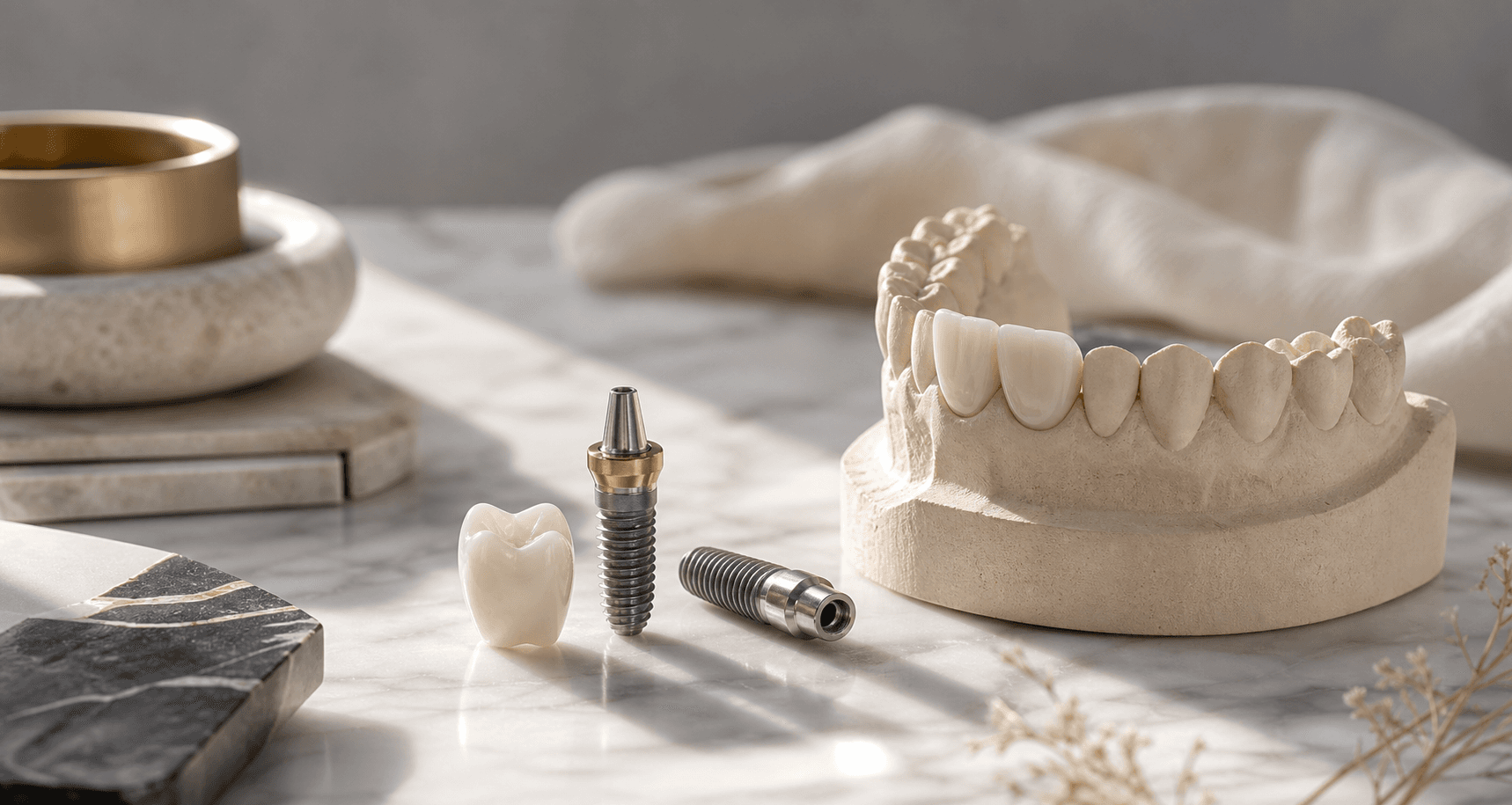
It helps to think of implant treatment as having at least three separate components that get priced individually: the implant post itself, any preparatory work needed before it can be placed, and the visible tooth attached on top once healing is complete. A quote that only mentions one of these numbers is not the full picture.
Because each component depends on your specific case, a straightforward single-tooth implant in a patient with plenty of healthy bone looks nothing like a full-arch case for a patient who needs grafting first. Both are "dental implants" in casual conversation, but they are entirely different treatment plans with different timelines and different costs.
Bone quality and grafting
The single biggest factor in most implant quotes is whether the jawbone at the site needs any preparation before an implant can be placed. When a tooth has been missing for a while, the bone that used to support it can gradually lose volume, since it no longer gets the stimulation from a tooth root. If there is not enough bone to anchor the implant securely, a graft is used to rebuild it first.
Grafting can range from a minor addition placed at the same time as an extraction, to a more involved procedure that needs months of healing before the implant itself can go in. Each level adds its own appointment, its own healing time, and its own cost, which is why two patients who both need "one implant" can end up with very different overall plans depending on how their bone has held up.
How many teeth are being replaced
A single missing tooth and a full arch of missing teeth are priced completely differently, and not in a simple per-tooth multiplication. Replacing an entire arch does not usually mean one implant for every missing tooth — a fixed bridge or an implant-secured denture can be supported by a smaller number of implants placed at specific points, engineered to carry the full arch.
That means the relevant question is less "how many teeth am I missing" and more "how many implants does this plan actually need to support them, and what goes on top." A consultation is where that number gets worked out, based on your bone, your bite, and which style of replacement — fixed or removable — you and your dentist decide fits you best.
The crown, bridge, or denture material
The visible part of an implant is a separate cost from the post underneath it, and the material used affects both durability and price. Crowns and bridges can be made from different materials with different strength, appearance, and longevity trade-offs, and a denture that clips onto implants is priced differently again from a fixed bridge that does not come out.
This is also where personal priorities matter. Some patients want the most natural-looking result for a front tooth and are willing to prioritize that; others are replacing a back molar where strength under chewing force matters more than appearance. Your dentist can walk through the realistic options for the specific tooth or teeth involved, rather than defaulting to one material for everyone.
Sedation and staging
Most single-implant placements are done comfortably under local anaesthetic alone, similar to other routine dental procedures. More involved cases — multiple implants in one visit, combined grafting and placement, or patients with significant dental anxiety — sometimes call for sedation, which is its own added consideration in a treatment plan.
Staging is another factor. Some cases can be planned in fewer visits, while others are deliberately broken into stages — extraction and healing, then grafting and healing, then implant placement and healing, then the final tooth — because rushing any one step risks the long-term stability of the result. A plan with more stages generally reflects more healing time being respected, not inefficiency.
Private insurance and the CDCP implant exclusion
Dental insurance plans vary widely in how they treat implants. Some plans cover a portion of the crown but treat the implant post itself differently, or apply an annual or lifetime maximum that a multi-stage implant plan can exceed. It is common for insurance to offset part of the cost without covering the full plan, which is why understanding your specific policy matters before treatment begins.
Implants and implant-supported prostheses are excluded from CDCP coverage.
The one promise that does apply: a written quote
Given how many variables go into an implant plan, the only responsible way to talk about cost is after an exam, not before one. What we can promise, regardless of how complex or simple your case turns out to be, is a clear, itemized written quote before any treatment begins — covering each stage, what it involves, and where private insurance coverage may apply, if you have it.
If you are comparing quotes from more than one office, it is worth asking each one the same question: what exactly is included in this number, and what stages, if any, are not. That is usually where the real difference between quotes becomes clear, far more than any single headline figure.
If you are missing one tooth or several and want an honest sense of what your specific plan would involve, a consultation is the place to start. We will look at your bone and bite, explain the stages that apply to your case, and put it all in writing before you decide anything.