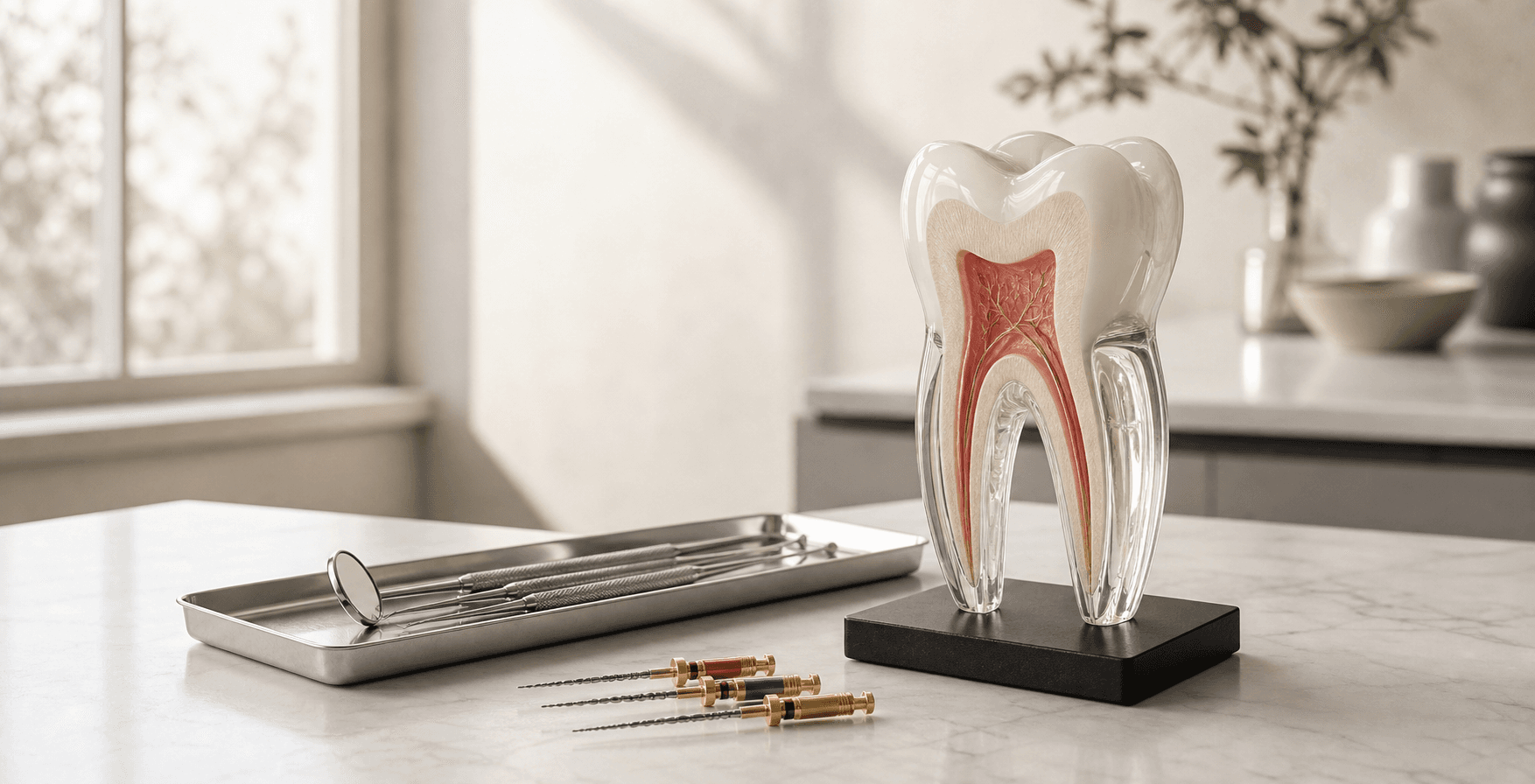

When a dentist tells you a tooth is infected or badly damaged, you are usually facing one of two paths: try to save the tooth with a root canal, or remove it with an extraction. Both are routine, well-established procedures, and both can be the right answer depending on the tooth. What often trips people up is not the procedure itself but the decision — which one actually makes sense for their situation, and why a dentist recommends one over the other.
This is not a simple better-or-worse comparison. A root canal and an extraction solve the same immediate problem — stopping pain and infection — in different ways, with different long-term consequences. Understanding how that decision gets made can make the conversation with your dentist far less confusing, whether you are weighing it for yourself or a family member.
Two procedures, one starting point
Both a root canal and an extraction usually begin from the same place: a tooth with a problem serious enough that a filling alone will not fix it. That might be deep decay that has reached the nerve, a crack that runs below the gumline, or an infection that has been building for a while, sometimes without obvious symptoms until it flares up.
From that starting point, the two treatments diverge completely. A root canal removes the infected or inflamed tissue from inside the tooth, cleans and seals the space, and leaves the outer tooth structure in place to be restored, usually with a crown. An extraction removes the entire tooth, root and all, closing that chapter but opening a new question: what, if anything, goes in its place.
Neither option is inherently the aggressive one or the conservative one. A root canal can sound like the bigger intervention because it involves more appointments, but it is the option that keeps your natural tooth. An extraction can sound simpler because it is often a single visit, but it typically sets up a longer conversation about replacement down the road.
When saving the tooth is the right call
A root canal tends to make the most sense when enough healthy tooth structure remains to support a restoration afterward. If the crown of the tooth — the part above the gumline — is largely intact, and the roots are not fractured, a root canal followed by a crown can return the tooth to full function for a long time.
It also matters where the tooth sits in your mouth. Back molars do a disproportionate share of the work when you chew, and losing one can shift how you bite on that side. Front teeth carry less chewing load but matter more for appearance and speech. In both cases, keeping your own tooth generally preserves your bite and your jawbone better than any replacement can, which is a big part of why dentists lean toward saving a tooth whenever it is realistic.
Your overall dental history matters too. If the tooth in question is otherwise healthy and the problem is isolated to the nerve, a root canal addresses that specific issue without touching the rest of your mouth. If several other teeth nearby are also compromised, that broader picture sometimes changes the calculation.
When extraction is the more realistic option
Sometimes a tooth is damaged beyond what a root canal can reasonably fix. A fracture that runs vertically down the root, a crown-to-root ratio too poor to support a restoration, or gum disease that has already loosened the tooth from its socket are all situations where saving the tooth is unlikely to hold up, even with treatment.
Extraction can also be the more sensible choice when a tooth has already failed a previous root canal and the infection persists, or when there simply is not enough healthy structure left above the gumline to anchor a crown. In these cases, attempting to save the tooth may only delay the same outcome while adding cost and time along the way.
There are situations where extraction is planned rather than reactive — clearing space before orthodontic treatment, or removing a wisdom tooth that is impacted and causing problems for its neighbours. Those are different conversations from an infected tooth, but they follow the same principle: the tooth is removed because keeping it would cause more harm than good.
The long-term consequences of extraction
The part of this decision that is easiest to underestimate is what happens after an extraction, once the socket has healed. A gap left by a missing tooth does not stay static. Neighbouring teeth can gradually tip or drift into the space, and the tooth that used to bite against it can start to shift too, since it no longer has anything to meet. Over months and years, that can change your bite in ways that are harder to correct the longer they go unaddressed.
There is also a bone consideration. The jawbone under a tooth is kept dense partly by the pressure of chewing transmitted through that tooth's root. Once the tooth is gone, that stimulation stops, and the bone in that area can gradually lose volume — a process that continues quietly for years. This matters most if you are considering a dental implant later, since implants depend on having enough bone to anchor into.
None of this means extraction is the wrong choice when it is the right one for the tooth. It simply means that removing a tooth is rarely the end of the story. Most people who have a tooth extracted eventually look at replacing it with an implant, a bridge, or a denture, and that replacement is its own process with its own timeline. Factoring that into the decision upfront, rather than after the extraction, tends to lead to better outcomes.
Common myths worth clearing up
One persistent myth is that pulling a problem tooth is the simpler, safer choice, full stop. It is often the quicker appointment, but simpler in the chair does not mean simpler over the following years, once bone changes and replacement planning enter the picture.
Another myth is that root canals are unusually painful or risky. In reality, the discomfort people associate with a root canal is almost always the infection that existed before treatment, not the procedure itself, which is performed under local anaesthetic much like a deep filling. Claims that root canals cause unrelated illness are not supported by credible dental or medical evidence.
A third myth is that a tooth with a root canal is fragile and doomed to fail. With a properly placed crown and reasonable home care, a root canal-treated tooth can function for many years, sometimes for the rest of your life. Like any tooth, it still needs regular checkups and good hygiene, but it is not inherently more fragile in daily use.
How this decision actually gets made
In practice, this is not a decision you make alone from a set of general rules — it depends on an exam and, usually, an X-ray of the specific tooth. Your dentist looks at how much healthy structure remains, whether the roots are intact, how the infection or damage is affecting the surrounding bone and gum, and how the tooth fits into your overall bite and treatment history.
Our approach is to lay out both paths honestly: what saving the tooth would involve, what removing it would involve, and what each one means for your mouth over the next several years, not just the next few weeks. If a tooth can realistically be saved, we will usually recommend trying, since keeping your natural tooth tends to be the better long-term outcome. If it cannot, we will say so plainly rather than attempting a treatment unlikely to hold up.
If you are dealing with a toothache, a cracked tooth, or a dentist elsewhere has already suggested an extraction and you would like it explained more fully or reconsidered, an exam is the place to start. We can look at the tooth, talk through what a root canal would involve for that specific case, and help you weigh it against extraction with a clear picture of what comes next either way.