
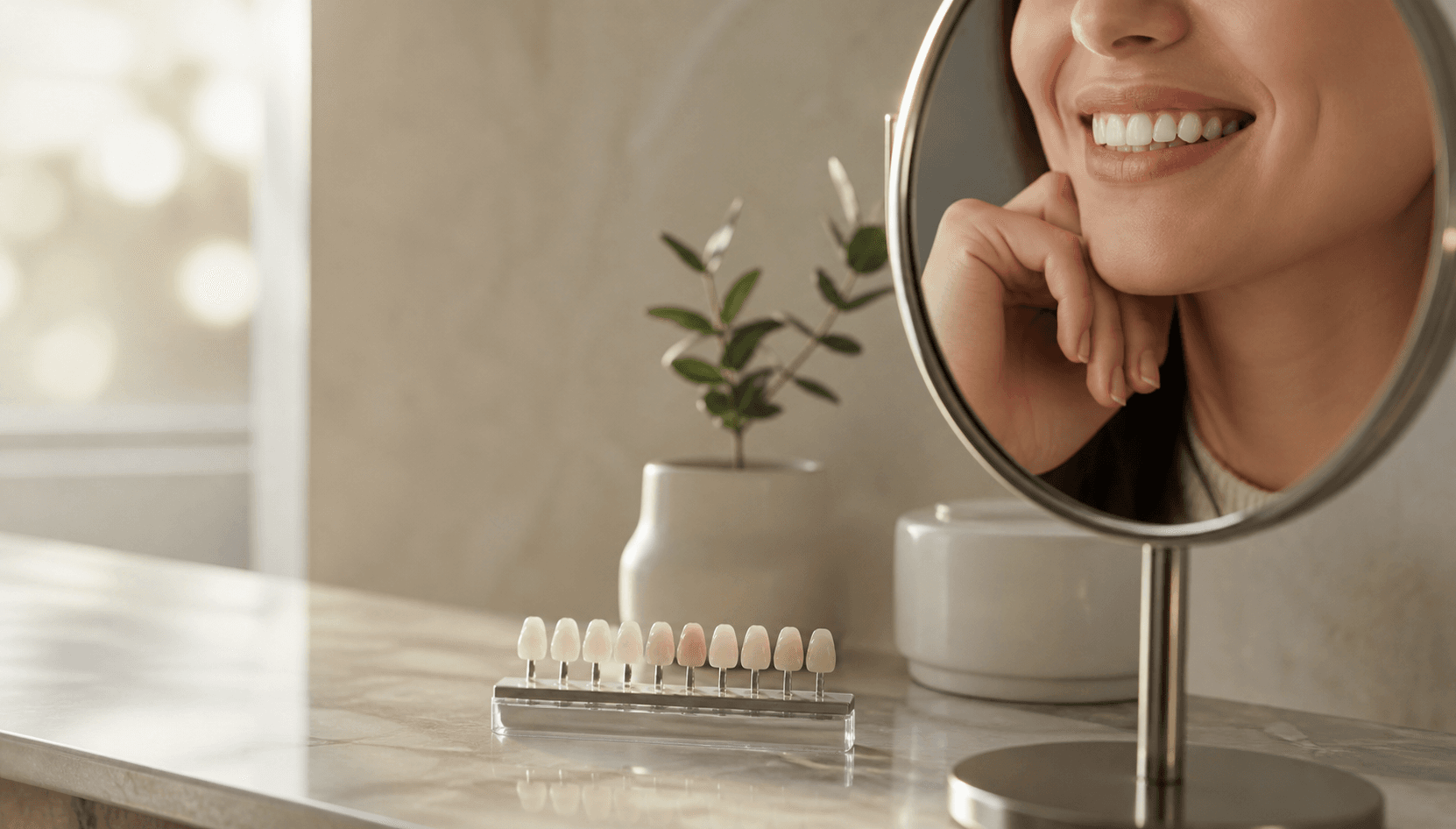
Whitening is one of the more crowded corners of dental care, with options ranging from a single in-office visit to drugstore strips you can pick up on your way home. They are not interchangeable, and the right choice depends less on which is 'best' overall and more on your teeth, your timeline, and how you want to manage the process.
This guide compares the three main routes — professional in-office whitening, custom take-home trays, and over-the-counter products — honestly, including where each one falls short, so you can make a decision with a fuller picture rather than marketing claims alone.
How whitening works, regardless of method
All whitening methods rely on the same basic mechanism: a peroxide-based gel breaks down stain molecules within and on the surface of the tooth, lightening its overall shade. What differs between methods is the concentration of that gel, how evenly and precisely it is applied, and whether a dentist is supervising the process.
This is why stronger, professionally applied gel tends to whiten more predictably than a weaker over-the-counter version, and why fit matters as much as formula — a gel that only touches part of a tooth will whiten unevenly, regardless of how strong it is.
In-office whitening
In-office whitening is done in a single appointment, with a dentist applying a professional-strength gel under controlled conditions, including protecting your gums beforehand. The main advantage is speed and control: results are visible after one visit, and any sensitivity that comes up during the session can be managed immediately rather than discovered later at home.
The trade-off is that a single in-office session, while faster, is a one-time event rather than something you can easily repeat on your own schedule. Some people combine an in-office session with take-home trays afterward for maintenance, which tends to give the most durable result of the three options.
In-office whitening tends to suit people who want a visible result before a specific date, or who would rather have a dentist manage the whole process directly, including watching for sensitivity as it happens.
Custom take-home trays
Custom trays are made from an impression of your own teeth, so the whitening gel sits evenly against every tooth surface rather than shifting or gapping the way a generic tray or strip can. You use them at home over roughly one to two weeks, with a dentist checking in on your progress and adjusting gel strength if sensitivity comes up.
The main advantage of trays is flexibility paired with an even result — you fit whitening around your own schedule rather than a single appointment, and because the trays are custom-fitted, the outcome tends to be more consistent across all your teeth than off-the-shelf alternatives. You also keep the trays afterward, which makes future top-ups straightforward without starting the process over.
The trade-off is that trays take longer to reach a final result than an in-office session, and they require some consistency on your part — skipping days can stretch out the timeline. For people without a firm deadline, this is rarely an issue.
Over-the-counter strips and whitening toothpaste
Drugstore strips, gels, and whitening toothpaste are the most accessible option and can help with mild surface staining, particularly from things like coffee or tea. They are worth being realistic about, though: the gel concentration is capped well below what is used professionally, and a generic strip or tray does not fit your teeth the way a custom one does, which can lead to uneven results, especially near the gumline and between teeth.
Whitening toothpaste in particular tends to work on surface stains through mild abrasion rather than meaningfully changing the underlying tooth shade, so expectations should be modest. It can be a reasonable maintenance step between more thorough whitening sessions, but it is not a substitute for one.
Over-the-counter products also do not come with the same oversight — there is no dentist checking that your teeth and gums are healthy enough to whiten first, and no one adjusting strength if sensitivity becomes uncomfortable partway through a course of strips. For mild staining and a limited budget for supervision, this can still be a reasonable starting point, as long as expectations are kept realistic.
Managing sensitivity, whichever method you choose
Some sensitivity during whitening is common across all three methods and is usually temporary, often felt as brief twinges with cold that settle within a day or two of finishing. With professional supervision, whether in-office or with trays, a dentist can lower the gel strength or space out sessions if sensitivity becomes uncomfortable. With over-the-counter products, that adjustment is left entirely to you, which is worth factoring in if you already have sensitive teeth.
If you know you are prone to sensitivity, mentioning it before starting any whitening method, professional or not, allows for a more cautious pace from the outset rather than adjusting after discomfort has already set in.
Who should be cautious about whitening
Whitening is not automatically right for everyone, regardless of method. It is generally approached with caution during pregnancy, and many dentists suggest waiting until afterward as a conservative precaution. Teeth with untreated decay or gum inflammation should typically be addressed first, since whitening a compromised tooth or irritated gum tissue is not advisable.
It is also worth knowing that none of these methods will change the colour of existing dental work — crowns, veneers, and fillings stay the shade they were made in, regardless of how the surrounding natural teeth respond. If you have visible restorations near the front of your mouth, this is worth discussing before you start, so the outcome does not surprise you.
Deep grey staining, such as staining linked to certain medications taken during tooth development, tends to respond less predictably to any whitening method, professional or otherwise. In these cases, a dentist can help set realistic expectations or discuss whether a different cosmetic approach might serve you better.
Choosing what fits you
There is no single right answer among the three options — the better fit depends on your timeline, your budget for supervision, and how your teeth respond to whitening in general. If you want a visible result before a specific date and would rather have it managed start to finish in one sitting, an in-office session tends to suit that best. If you would rather work at your own pace with an even, custom fit and the option to top up later, take-home trays are usually the better match. If your staining is mild and you mainly want to freshen things up between more thorough sessions, an over-the-counter product can have a place, with realistic expectations about how far it can go.
Whichever direction you lean toward, a conversation with a dentist about teeth whitening beforehand, even briefly, helps confirm your teeth and gums are a good candidate and gives you a realistic sense of the shade change you can expect before you commit to a method.