
Cosmetic care · Patient education
Veneers or bonding? Decide what needs to change first
Compare a localized composite repair with porcelain veneers by tooth preparation, coverage, maintenance and the change you actually want.
Clinically reviewed by Dr. Ghazala Zaid · 2026-09-13
Published
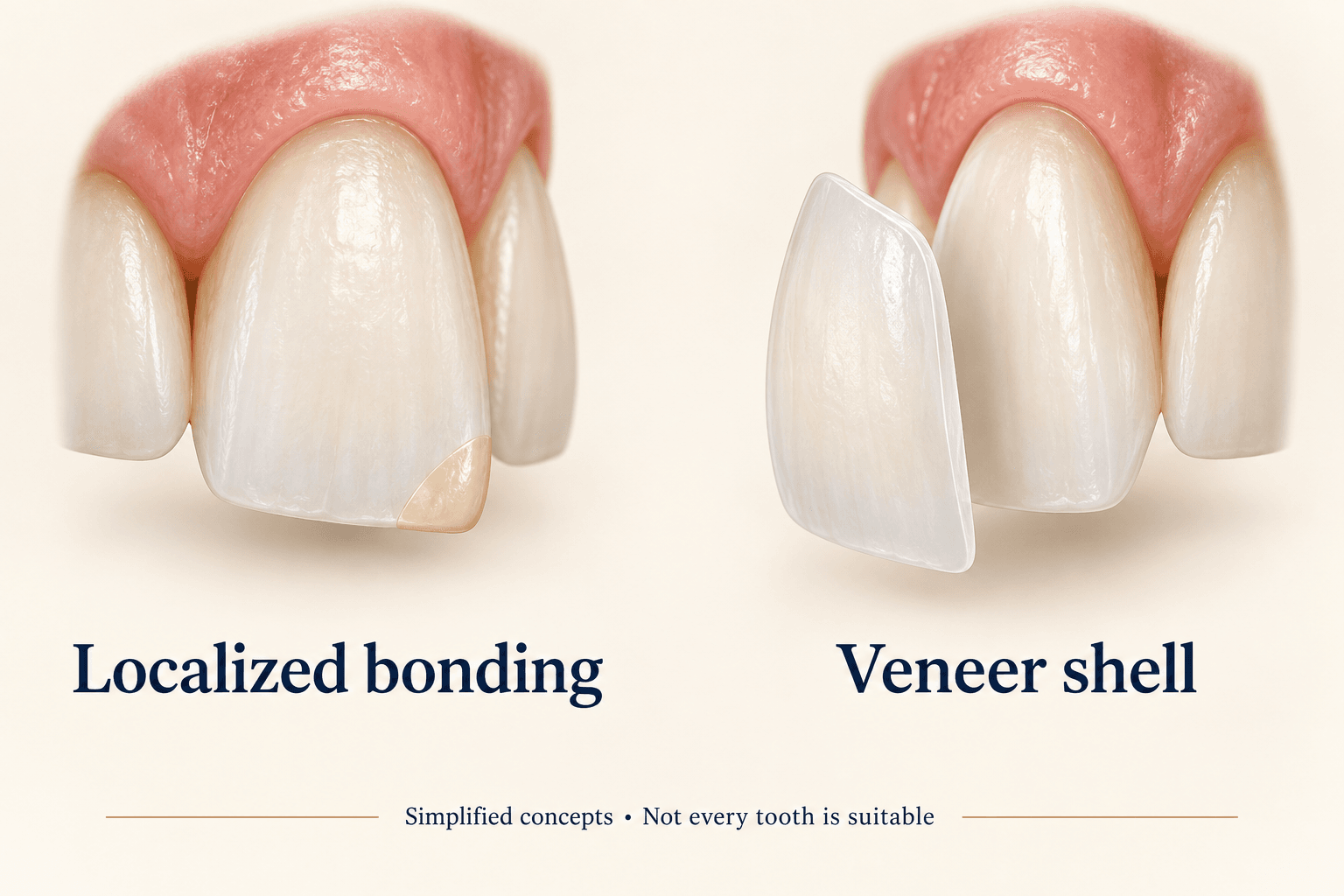
- 1. Localized composite
- 2. Veneer
Labels run left to right. AI-generated teaching illustration. Simplified concepts. Not every tooth is suitable.
Compare these options interactively
Hides rows with identical wording, not a clinical judgment that two options are equivalent. Selections stay on this page.
Comparing Localized composite bonding with Porcelain veneer · 4 rows shown
Option ALocalized composite bonding
Option BPorcelain veneer
What area changes?
- Localized composite bonding
- A selected defect or contour
- Porcelain veneer
- A covering across the front surface
What is the material?
- Localized composite bonding
- Composite resin shaped on the tooth
- Porcelain veneer
- A custom porcelain restoration
What should I ask about preparation?
- Localized composite bonding
- What tooth surface will be altered?
- Porcelain veneer
- How much enamel must be removed?
What happens after damage?
- Localized composite bonding
- Ask whether a localized repair is possible
- Porcelain veneer
- Ask about repair, rebonding or replacement
Keep the context
Compare a localized composite repair with porcelain veneers by tooth preparation, coverage, maintenance and the change you actually want.
Read the full guide and sourcesTake the comparison to your dentist
Availability and suitability need confirmation. An appointment request is not a confirmed booking.
If a small chip, uneven edge or tooth colour bothers you, it is easy to start by asking for a particular cosmetic treatment. A better starting point is to describe the change you want. The smallest suitable intervention may be different from the treatment name you first had in mind.
This guide compares localized composite bonding with porcelain veneers. The terminology matters: composite can also be used to create a veneer, so “bonding versus veneers” does not always describe two completely separate materials or procedures.
Clarify the design, not just the label
The Canadian Dental Association describes bonding as using tooth-coloured resin for smaller changes, while veneers cover the front of a tooth. Ask whether the proposal is a repair to one edge, a broader composite covering or a custom porcelain shell.
That distinction helps you compare like with like. A repair to one chipped corner and veneers across several teeth have different goals. Explore our veneer information and bonding information, then ask the dentist to point out exactly what would be changed on each tooth.
Compare preparation and future care
Your dentist needs to assess the teeth, gums and bite before discussing appearance changes. The American Dental Association explains that problems such as decay or gum disease need attention first, and veneer treatment involving enamel removal is not reversible. Veneers can also need repair or replacement over time.
| Planning question | Localized composite bonding | Porcelain veneer |
|---|---|---|
| What area changes? | A selected defect or contour | A covering across the front surface |
| What is the material? | Composite resin shaped on the tooth | A custom porcelain restoration |
| What should I ask about preparation? | What tooth surface will be altered? | How much enamel must be removed? |
| What happens after damage? | Ask whether a localized repair is possible | Ask about repair, rebonding or replacement |
This table is a conversation aid, not a recommendation. The extent of preparation and the suitability of repair depend on the actual tooth and design. Avoid treating “minimal preparation” as a promise that nothing permanent will change.
Keep alternatives in the conversation
Ask what happens if you do nothing for now. If colour is the main concern, ask whether whitening could be considered before altering tooth shape. If position is the concern, ask whether moving teeth would address the issue differently from covering them.
Request a written plan with the number of teeth, materials, proposed preparation, visits and follow-up. If you see a mock-up, clarify what it demonstrates and what it cannot predict. A photograph can help communicate taste; it cannot establish the right treatment for your bite.
Think beyond the first appointment. Ask about routine cleaning, habits that could damage the restoration and how future repairs would be assessed. Make sure the estimate separates optional appearance changes from work needed for the tooth’s health. There is no obligation to change every visible tooth simply because you are discussing one concern.
Common questions
Is bonding always reversible?
Do not assume that. Ask what surface preparation is proposed and what removing or replacing the resin would involve for your tooth.
Are veneers a permanent, maintenance-free solution?
No. Enamel removal may be permanent, but the restoration itself may eventually need attention. Discuss the long-term maintenance commitment before proceeding.
Does a small chip automatically need a veneer?
No. The visible chip is only part of the assessment. Ask whether polishing, localized repair, monitoring or another option is appropriate.
You can request an appointment to discuss your goals without choosing a procedure beforehand. Appointment requests require office confirmation.
Sources
- CDA: Bonding and veneers, checked 2026-09-13.
- ADA MouthHealthy: Veneers, checked 2026-09-13.
Understand what makes sense for you.
Bring your questions to Cedarbrae Dental Center in Scarborough. We can assess your needs and discuss appropriate options. An appointment request is not a confirmed booking.